


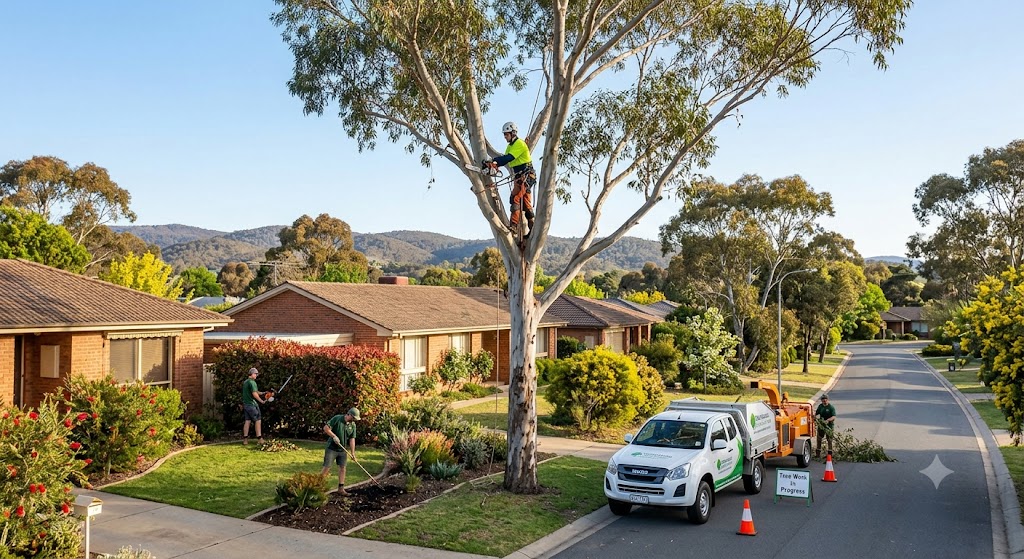
25 Oct Sectional Tree Removal in Sydney
Tetris with a Chainsaw: Taking a Big Tree Down Piece by Piece in a Tiny Sydney Backyard
Picture the scene. A 14-metre tree out the back. A Colorbond fence on each side. A neighbour’s pergola on the left, your own Hills hoist on the right, and a side gate narrower than a Bunnings trolley. The tree has to go, but there’s no room to say “timber!” and let it fall wherever it likes.
Welcome to the everyday puzzle that crews at Sydney Tree Felling solve across the city, from Inner West terraces to Hills District battle-axe blocks. The answer is almost never “chop it down in one go.” It’s sectional tree removal: the tree comes down in controlled pieces, top to bottom, one carefully planned cut at a time.
If you’ve ever wondered what actually happens in your yard on the day, here’s the full play-by-play, minus the jargon and with a few dad jokes thrown in free of charge.
What Is Sectional Tree Removal (and Why Can’t They Just Fell It Whole)?
Sectional tree removal, also called sectional dismantling or top-down removal, means an arborist climbs the tree and cuts it apart in small, manageable sections. Each piece is roped off and lowered to the ground under control, rather than dropped.
Traditional felling needs a clear drop zone, roughly the height of the tree plus a safety margin. Most Sydney backyards simply don’t have it. Houses, sheds, pools, fences, powerlines and neighbours all sit inside that zone. A tree that falls even slightly off line can wreck a roof, flatten a fence or wipe out a very expensive barbecue.
That’s why for any confined backyard tree removal in Sydney, sectional work is the safer, smarter method. It’s slower than a one-cut felling, sure, but it’s the difference between a tidy job and an insurance claim.
If you want the big picture on what’s involved before you commit, our professional tree removal and felling service page covers the different methods we use, and our wider range of tree services in Sydney shows what else can be done in the same visit.
Step 1: The Site Walk (Where the Real Work Starts)
Before a single chainsaw gets started, a good tree company Sydney homeowners can trust will walk the site with you. This isn’t a formality. It’s where the job is won or lost.
During the walk-through the arborist will look at:
- The tree itself: species, height, lean, dead wood, rot, splits and any signs of decay. A healthy fig behaves very differently to a half-dead gum.
- The access: can equipment come through the house, down the side, or over the fence? Is the gate wide enough for a chipper?
- The targets: roofs, powerlines, pools, solar panels, glass, pergolas, neighbouring structures.
- The rigging points: which parts of the tree are strong enough to anchor ropes and take the load of heavy sections.
- The drop and lowering zones: where cut timber will land, and what needs protecting first.
You’ll get a plain-English plan and a quote. If someone quotes you over the phone without seeing the tree, be a bit suspicious. Every Sydney backyard has its own quirks.
Step 2: Permits and Paperwork (Yes, Really)
Here’s the bit nobody finds exciting, but it matters. Many Sydney councils protect trees above a certain size or of certain species, and removing one without approval can lead to fines. Rules vary from council to council, so always check with yours before any work is booked in.
A reliable crew will tell you straight whether your tree is likely to need approval, and may recommend an arborist report to support the application. Trees near powerlines also need extra planning, because working close to live lines is a specialist job and not a DIY adventure.
Not sure where you stand? Get in touch with our team and we’ll point you in the right direction before anyone picks up a saw.
Step 3: Prep Day Magic, Protecting Your Yard
Tight yards need a bit of choreography. Before cutting begins, the crew will:
- Clear the work zone. Outdoor furniture, pots, kids’ toys and that suspicious pile of timber behind the shed all need to move.
- Protect what can’t move. Ground protection mats, ply sheeting or old-school plywood go down over lawns, paving and pool surrounds.
- Set the exclusion zone. Everyone, including the dog, the kids and the curious neighbour, stays out of the area under the tree.
- Check the gear. Ropes, harnesses, carabiners, pulleys and saws are inspected before they’re trusted with anyone’s weight.
Step 4: Up the Tree and Into the Rigging
Now the arborist climbs, using ropes and a harness, and sets up the rigging system. Think of it as installing a very strong, very clever pulley setup inside the tree.
In a confined yard there’s often no room for swinging or guesswork, so the climber chooses rigging points carefully. Heavy sections get lowered on controlled ropes, often through a friction device attached to a strong anchor point. That device lets the ground crew ease the load down like a slow-motion elevator instead of a free fall.
Where ropes alone can’t do the job, there are other options. A crane or elevated work platform can be used for very large trees or yards with truck access. If the yard is truly tiny and the access is by foot only, rope-and-pulley work does the heavy lifting.
Step 5: Cutting Top Down, One Piece at a Time
This is the part everyone pictures, and it’s far more methodical than the movies suggest.
The arborist works from the top of the tree to the bottom:
- Small branches first. Outer foliage and smaller limbs are cut and either dropped safely into a clear area or lowered by rope.
- Larger limbs next. Bigger branches are tied off, cut, then lowered under control so they never swing into the house or the fence.
- The trunk last. Once the crown is gone, the trunk is taken down in sections, from the top working down. Each section is secured before the cut, then eased to the ground.
Every cut is planned. The climber figures out where the weight will go, what the rope will do, how the tree will react, and what needs to be in place before the cut is made. That’s the “Tetris” bit: pieces fit together in the right order, nothing falls where it shouldn’t, and the pile on the ground ends up neat.
Step 6: Where All That Wood Goes
A tree of any size produces a staggering amount of material. A single mature tree can fill a small truck with branches alone, and the trunk is a whole other story.
Here’s how a good crew handles it:
- Branches and leaves go through a chipper. The chips can be turned into mulch for garden beds, which is a lovely way for your old tree to keep working.
- Logs are cut into sizes that can be carried or hauled out. Some are kept for firewood, some are removed.
- Green waste and offcuts are bagged or loaded up and taken away.
If you’re curious about where all that chipped timber ends up, see our tree mulching and woodchipping service. It’s also a handy option if you’re after organic mulch supply in Sydney for garden beds, veggie patches and that sad strip down the side of the house.
Step 7: The Stump, the Last Stubborn Bit
Once the tree is down, you’re left with a stump that just refuses to leave. You’ve got a few choices:
- Leave it. Cheapest, but it can regrow, attract pests and become a trip hazard.
- Grind it. A stump grinder chews the wood below ground level, leaving wood chips and a flat patch you can lawn over or plant on. See our stump grinding and removal service for how it works.
- Remove it completely. This is more invasive and sometimes needed if you’re building over the spot.
In a tight yard, a compact stump grinder is the hero. These machines are small enough to roll through narrow gates, and they save you from digging up half the backyard.
Step 8: Clean-Up and Waste (The Bit You’ll Actually Notice)
A job’s not done until the yard is tidy. The crew will rake, blow and sweep, remove the ground protection and clear the leaf litter, sawdust and little twigs that somehow end up in places they shouldn’t.
Anything left over, including old fence palings, dumped garden bits or that mystery pile from three summers ago, can be cleared as part of our garden waste removal and rubbish removal service. Just let the crew know on the day so it’s all sorted in one hit.
What Affects the Cost of Sectional Tree Removal?
Nobody can give an honest price without seeing the tree, but here’s what moves the needle:
- Height and trunk size. Bigger trees take more time, rigging and effort.
- Access. If every log has to be carried through your lounge room, expect that to show up on the quote.
- Proximity to hazards. Powerlines, roofs and neighbouring structures add complexity.
- Equipment needed. Cranes, elevated platforms and extra crew all influence the price.
- Waste volume. More branches and trunk means more chipping and more removal.
- Stump grinding and extras. Usually quoted separately, so ask.
- Permits or arborist reports. If your council requires them, they add to the process.
Always get a written quote, ask what’s included and don’t be afraid to ask for a few details about insurance and experience. A reputable crew will be glad you asked.
Beyond the Tree: Everything Else That Tags Along
Tree removal rarely happens in isolation. Once the big job’s done, a lot of yards need a bit more love.
- Pruning the neighbours. Nearby trees might need a trim, and professional tree trimming and pruning keeps them healthy and safe. It’s also a great way to explore tree shaping services in Sydney, with crown reduction, lifting and shaping to keep canopies tidy without hacking them to bits.
- Clearing more space. Planning a granny flat, pool or shed? Our land clearing and site preparation team handles everything from land stump clearing in Sydney to full block clearing, so the site is ready for what comes next.
- Gutters. Trees and gutters have a tragic history. Leaves, seed pods and bark love to settle in there. If you’re booking tree work anyway, ask about gutter cleaning in Sydney while the crew is on site.
How to Choose a Tree Company in Sydney Without Getting Burned
Searching for tree services in Sydney will throw up a giant list of options. Here’s how to separate the pros from the pretenders:
- Ask about insurance. If something goes wrong, you want proper cover in place.
- Look for experience in tight spaces. Ask for examples of confined or complex jobs.
- Get the process explained. A good arborist can tell you how they’ll do the job, step by step.
- Trust your gut. If someone’s pushy, vague or can’t give you straight answers, move on.
Want to dig deeper into tree care before you decide? Our blog is full of practical tips for Sydney homeowners.
Sectional Tree Removal FAQs
How long does a sectional tree removal take in a small backyard?
It depends on the size and condition of the tree, the access and the amount of rigging needed. A small to medium tree might be done in a few hours, while a large tree in a tight yard can take a full day or more. Sectional work is more methodical than felling, so the timeframe is usually longer, but it’s far safer.
Will the crew damage my lawn, fence or garden beds?
A professional crew uses ground protection, careful rigging and controlled lowering to keep damage to a minimum. Some marks from foot traffic or heavy timber are always possible on soft ground, but a good team will tell you upfront what’s likely and what they’ll do to reduce it.
Do I need council approval to remove a tree in Sydney?
Often, yes. Many councils protect trees by size, species or location, and rules vary across Sydney. Check with your local council before you book. If approval is needed, an arborist report can help with the application. Taking a tree out without permission can lead to hefty fines.
What happens if my tree is close to powerlines?
Work near powerlines needs extra planning and, in some cases, coordination with the network provider. It’s not something to attempt yourself. A qualified crew will assess the risk and explain how they’ll manage it.
What happens to all the branches and logs?
Branches are typically chipped into mulch, logs are cut for removal or firewood, and the green waste is taken away. If you want the mulch back for your own garden beds, mention it before the job starts.
Ready to Tackle That Tricky Tree?
A big tree in a small backyard doesn’t have to be a big headache. With the right planning, the right gear and a crew that’s done it a hundred times before, sectional tree removal is a controlled, tidy, almost satisfying process.
At Sydney Tree Felling, we handle the whole show: tree removal, trimming, stump grinding, mulching, waste clearing and even the gutters afterwards. Contact us to book a site visit, and visit the Sydney Tree Felling home page to see everything we do.
Your backyard will thank you. So will your neighbours.