


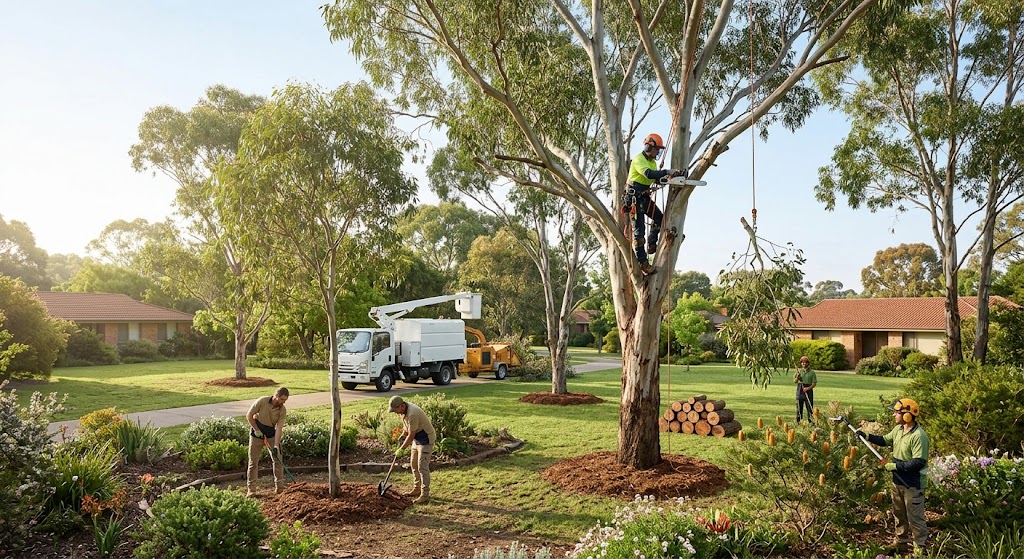
27 Sep Reduce Storm Damage Risks with Professional Tree Service
Ask any Sydneysider what a good storm looks like and you’ll get two very different answers. Half of us love it — the drama, the drop in temperature, the excuse to watch a movie instead of mowing the lawn. The other half are already outside at 6pm, torch in hand, checking whether that big old gum is leaning a bit more than it used to.
Both reactions are fair. But only one of them keeps your roof intact.
Sydney doesn’t do storms by halves. Between the summer east coast lows, the sudden southerly busters that roll in off nothing, and the increasingly wild swings between drought and downpour, our trees cop a hiding most years. And here’s the bit nobody wants to hear: it’s rarely the storm itself that causes the damage. It’s the tree that was already compromised, quietly waiting for one strong gust to finish the job.
That’s where a proper tree company Sydney homeowners can actually trust earns its keep. Not just turning up after the fact to clean up a mess on your driveway, but getting ahead of the problem so the mess never happens. This is what we do at Sydney Tree Felling, and honestly, it’s the difference between a stressful phone call to your insurer and a quiet night’s sleep during the next big blow.
Why Sydney’s Trees Cop It Worse Than Most
It’s not just bad luck. A few things stack the odds against local trees:
- Shallow root systems. Sandstone country means a lot of our soil is thin, and plenty of established trees have roots that spread wide rather than deep. Great in a drought, not so flash when the ground’s saturated and the wind picks up.
- Sudden wet-dry swings. Long dry spells followed by heavy rain soften the soil fast, and a tree that’s stood firm for twenty years can suddenly lose its grip.
- Dense canopies acting like sails. Overgrown, top-heavy trees catch far more wind than a well-maintained one. More sail area, more leverage, more chance of a branch — or the whole tree — coming down.
- Older suburbs, older trees. Leafy pockets across the North Shore, Inner West and Eastern Suburbs are full of mature trees planted decades ago, some with internal decay you’d never spot from the footpath.
None of that means you need to start eyeing off every tree on the block with suspicion. It just means a bit of professional attention before storm season goes a long way further than crossing your fingers.
The Warning Signs Most People Walk Straight Past
Trees are surprisingly good at hiding structural problems. A tree can look perfectly healthy from your kitchen window and still be one gust away from trouble. A few things worth actually stopping and looking for:
- Cracks or splits in the trunk or major limbs, even hairline ones
- A noticeable lean that’s new, or seems to be getting worse
- Fungus or mushrooms growing near the base — often a sign of root or internal rot
- Deadwood sitting up in the canopy (grey, brittle, leafless branches among the green)
- Bark that’s peeling away in sheets rather than naturally shedding
- Roots that have visibly lifted or heaved the soil around the base
If any of that sounds familiar, it’s worth getting a proper set of eyes on it rather than hoping for the best. Our broader tree services cover exactly this kind of assessment work across Sydney, and it’s usually a lot cheaper than the alternative — which is a tree in your neighbour’s pool.
Pruning: The Unglamorous Job That Actually Saves Your House
Nobody gets excited about pruning. It doesn’t have the drama of a full removal or the satisfaction of watching a stump grinder do its thing. But if you’re serious about reducing storm damage risk, this is genuinely where most of the real work happens.
A tree with a thinned, well-balanced canopy lets wind pass through it instead of fighting against it. Reduce the dead weight, take out the crossing branches that rub and weaken each other, lower the centre of gravity on top-heavy specimens, and you’ve dramatically cut the odds of a limb ending up through your carport roof.
There’s a right and a wrong way to do this, though. Hacking off branches without understanding growth patterns can actually make a tree more storm-prone, not less — it can trigger weak, fast regrowth in exactly the wrong places. Proper tree trimming and pruning done with the right technique strengthens the tree’s structure for years, not just for one season.
When the Tree’s Past Saving
Sometimes the honest answer isn’t pruning, it’s removal. A tree with significant internal decay, a split trunk, or a root system that’s already failing isn’t a candidate for a haircut — it’s a liability standing next to your bedroom window.
This is usually the part where a DIY attempt goes badly wrong. A leaning or already-damaged tree can be under serious internal tension, and cutting into it without knowing what you’re doing is how people end up in hospital, not how they end up with a tidy backyard. Our tree removal and felling service handles exactly this kind of job — assessing whether a tree can be saved, and if not, taking it down safely with the right rigging, gear and experience, without turning your fence, pergola or Hills Hoist into collateral damage.
Stumps: The Storm Damage Nobody Talks About
Here’s one that catches people out. You’ve had a tree removed — maybe after a previous storm, maybe just because it was diseased — and the stump’s still sitting there. Out of sight, out of mind, right?
Not quite. Leftover stumps become a genuine hazard once heavy rain arrives. They’re a trip hazard in the dark when you’re rushing outside to check on things, they can encourage fungal growth that spreads to nearby healthy trees, and if they’re near a fence line or retaining wall, decaying root systems can actually undermine the structure over time. A proper stump grinding and removal job clears the ground completely, so there’s nothing left waiting to catch you or your mower off guard once the wet weather rolls through.
Clearing the Block Before the Season Turns
If you’re renovating, subdividing, or just dealing with an overgrown block that hasn’t seen a chainsaw in a decade, storm season is exactly the wrong time to be sorting it out mid-crisis. Overgrown vegetation, weak self-seeded trees and dense scrub all add up to more storm risk, not less — more material to become airborne, more weak growth competing for light and root space.
Getting ahead of it with proper land clearing and site preparation before the weather turns means your block goes into storm season tidy, assessed, and free of the kind of borderline vegetation that tends to come down first.
All That Green Waste Has to Go Somewhere
Every pruning job, removal or clearing project leaves behind a genuine mountain of branches, leaves and offcuts. Leaving it piled up isn’t just an eyesore — it’s fuel for pests, a fire risk in the drier months, and honestly just more work for you later.
Rather than letting it rot in a corner of the yard, most of it can be turned into something useful. Our tree mulching and woodchipping service processes the green waste on site, giving you mulch you can actually use on garden beds — which, as a bonus, helps retain soil moisture and reduces erosion around any remaining trees. Waste in, garden upgrade out. Not a bad trade.
Post-Storm Cleanup without the Backache
Say the storm’s already been and gone, and your yard now looks like it lost an argument with a wind turbine. Branches everywhere, a fence panel that’s seen better days, mud tracked through what used to be a lawn. This is where a lot of people try to power through it them over a weekend, and end up more exhausted than when they started.
Proper rubbish removal service clears storm debris quickly and properly, without you needing to hire a trailer, do six trips to the tip, or throw your back out lifting a waterlogged branch that’s twice as heavy as it looks. Sorted, hauled away and done.
The Gutter Problem Everyone Forgets
This one’s not strictly a tree job, but it belongs in this conversation because it’s directly caused by trees — specifically, the leaves and debris they drop into your gutters all year round. Come storm season, blocked gutters mean rainwater has nowhere to go except over the edge, down your walls, and potentially into your roof cavity.
It sounds minor compared to a falling branch, but blocked gutters cause a genuinely huge share of Sydney’s storm-related property damage every year. A quick gutter cleaning before the season kicks off is one of the cheapest, easiest bits of storm prep you can do — and it’s the one most people leave until water’s already coming through the ceiling.
Why DIY Storm Prep Usually Backfires
We get it — there’s a certain appeal to grabbing a chainsaw and having a crack yourself. But storm-affected and high-risk trees are a genuinely different job to trimming a hedge. Weight distribution, hidden decay, tension in bent or split limbs, proximity to power lines — professional crews train for years to read all of that correctly, and they carry the insurance and equipment to back it up.
A ladder, a borrowed chainsaw and good intentions aren’t a safety plan. If there’s any doubt at all about a tree’s condition, it’s worth getting it looked at properly rather than finding out the hard way halfway up a ladder in gale-force wind.
The Sydney Tree Felling Way
We’ve been doing this long enough to know that storm damage prevention isn’t one job, it’s a handful of smaller ones done properly and on time — a bit of pruning here, a stump cleared there, gutters sorted before the first big downpour. Sydney Tree Felling handles the whole lot, from routine maintenance right through to the kind of urgent, high-risk removal work that needs proper rigging and a crew who know what they’re doing.
If you want the full rundown of everything we cover, our tree services page is a good place to start, or head over to the homepage for an overview of how we work across Sydney. We’ve also got a growing collection of local guides and seasonal tips over on the blog if you’re the type who likes to plan ahead rather than react.
Either way, the smartest move before the next big system rolls through is getting someone qualified to look at your trees now, not after. Get in touch and we’ll sort out what your property actually needs.
FAQs
How do I know if my tree is actually a storm risk, or just ugly? Ugly and dangerous aren’t the same thing, thankfully. A tree can look scruffy and be structurally fine, or look perfectly healthy and be hollow at the core. The real indicators are things like cracks, fungal growth at the base, a new or worsening lean, and significant deadwood in the canopy. If you’re not sure, it’s genuinely worth getting a professional opinion rather than guessing from the back deck.
Does home insurance actually cover storm-damaged trees? Most Sydney home and contents policies cover damage a fallen tree causes to insured structures — your house, garage, fence in some cases — but coverage for simply removing a tree that’s fallen without hitting anything can vary a lot between insurers. It’s worth checking your specific policy, and keeping photos plus a paper trail from whoever does the removal work in case you need to make a claim.
Is it better to prune a tree hard before storm season, or leave it alone? Neither extreme is ideal. Over-pruning — taking more than about a quarter of the canopy in one go — can actually stress the tree and trigger weak regrowth. What actually helps is selective, well-planned pruning that removes deadwood and thins dense growth without shocking the tree. This is exactly why it’s worth having someone experienced do the assessment rather than eyeballing it with a pole saw.
Can I remove a stump myself instead of paying for grinding? You can try, but it’s rarely worth it. DIY stump removal with a shovel and sheer stubbornness usually takes a full weekend and often leaves root fragments behind, which can regrow or attract fungal issues. Professional stump grinding clears it properly in a fraction of the time and leaves the area ready for turf, garden beds or paving straight away.
Do council trees near my property get maintained for storm risk too? Trees on council land or nature strips are generally the council’s responsibility to inspect and maintain, though if a council tree is genuinely posing a risk to your property, it’s worth reporting it directly to your local council. For anything on your own block, though, the responsibility — and the risk — sits with you, which is exactly why regular checks matter.
How often should Sydney trees be inspected for storm readiness? As a rough guide, an annual check before the storm season ramps up (spring, typically) covers most residential properties well. Older or larger trees, or ones close to the house, are worth a closer look every six months, especially after any period of prolonged heavy rain that could have loosened the root system.
Sydney Tree Felling provides tree removal, pruning, stump grinding, land clearing, mulching, rubbish removal and gutter cleaning across Sydney. Get in touch before the next storm rolls through.