


11 Sep Dead Tree on Your Property? Know When Removal Becomes the Safer Option
There’s a particular kind of denial that Sydney homeowners get very good at. It’s the same energy as ignoring a check-engine light or pretending the smell in the fridge will sort itself out. Except this time, it’s a 15-metre gum tree standing three metres from your bedroom window, and “sorting itself out” usually means falling over in the next nor’-easter.
If you’ve been side-eyeing a tree in your yard for a few months now — no leaves, bark peeling like a bad sunburn, branches that snap if a currawong so much as lands on them — you already know something’s up. The question isn’t really “is my tree dead?” anymore. It’s “what do I do about it, and how fast?”
This one’s for anyone who’s Googled “dead tree removal Sydney” at 11pm after hearing a branch crack outside. Let’s talk about it properly.
How to Actually Tell a Tree Is Dead (Not Just Having a Bad Winter)
Plenty of native and deciduous trees go through rough patches — drought stress, a cold snap, a dodgy pruning job from three years ago — and bounce back. So before anyone reaches for a chainsaw, it’s worth knowing the difference between “resting” and “gone.”
A few genuine red flags:
- No new growth for a full season. If spring rolls around and there’s nothing but bare branches, that’s not a tree having a lazy year.
- Bark falling away in large sheets, exposing dry, grey timber underneath rather than green cambium.
- Brittle branches that snap cleanly instead of bending — healthy wood flexes, dead wood doesn’t.
- Fungal growth at the base or on the trunk, which usually points to internal decay you can’t see from the outside.
- A lean that’s new or getting worse, especially after wet weather, which can mean the root plate, is failing.
- A hollow sound when you tap the trunk, suggesting the inside has rotted out while the outer shell still stands.
One or two of these on their own might not mean much. A few together, especially on a large tree near a house, driveway, or fence line, is worth getting a second opinion on. That’s genuinely where a proper set of eyes from a tree removal and felling service earns its keep — someone who looks at hundreds of trees a year picks up on things a homeowner walking past every day simply stops noticing.
Why a Dead Tree Is More than Just an Eyesore
Here’s the bit nobody wants to hear: a dead tree doesn’t just sit there quietly being dead. It actively gets more dangerous the longer it’s left standing.
Live trees are flexible. They bend in wind, they shed water weight, and they’ve got a root system actively gripping the soil. Dead trees lose all of that. The wood dries out and becomes rigid, which means instead of swaying in a gust, a dead limb is far more likely to shear off entirely. Arborists have a name for a branch that’s already detached but hasn’t fallen yet, hung up in the canopy above — a “widowmaker” — and the name isn’t for laughs. Falling limbs are one of the more common causes of chainsaw and tree-related injuries in this country and most of them happen to people who thought they had a bit more time to deal with it.
Then there’s the root system. Once a tree dies, the roots stop actively holding the soil together the way a living root network does, particularly after heavy Sydney downpours saturate the ground. A tree that looked rock solid in January can be leaning by March. Add a storm — and let’s be honest, Sydney’s had a few cracking ones lately — and you’ve got a genuine hazard sitting over your roof, your car, or your neighbour’s fence.
This is the exact scenario where removal stops being a “maybe one day” job and becomes the safer option, full stop.
Removal or Just a Trim? Here’s the Actual Difference
Not every problem tree needs to come down entirely, and a good operator will tell you that upfront rather than pushing for the bigger, pricier job.
Pruning makes sense when:
- The tree is still alive, just carrying deadwood or overgrown limbs
- Branches are encroaching on the roofline, powerlines, or a neighbour’s yard
- The canopy needs thinning for light, airflow, or storm resilience
- You want to keep the tree but reduce weight on a weak limb
Removal is the call when:
- The tree is confirmed dead, not dormant
- There’s significant trunk decay or a compromised root plate
- It’s leaning toward a structure and getting worse
- The species or condition means it simply can’t be made safe with cuts alone
A decent way to think about it: pruning manages risk on a tree that can still be saved. Removal is what happens when the risk can’t be pruned away. If you’re not sure which camp your tree falls into, that’s worth a proper look from the tree trimming and pruning side of things before anyone commits to felling it — sometimes a tree that looks like a write-off just needs the dead sections taken out.
What Actually Happens on the Day
For anyone who’s never had a tree taken down, the process is a lot more methodical than “someone shows up with a chainsaw.”
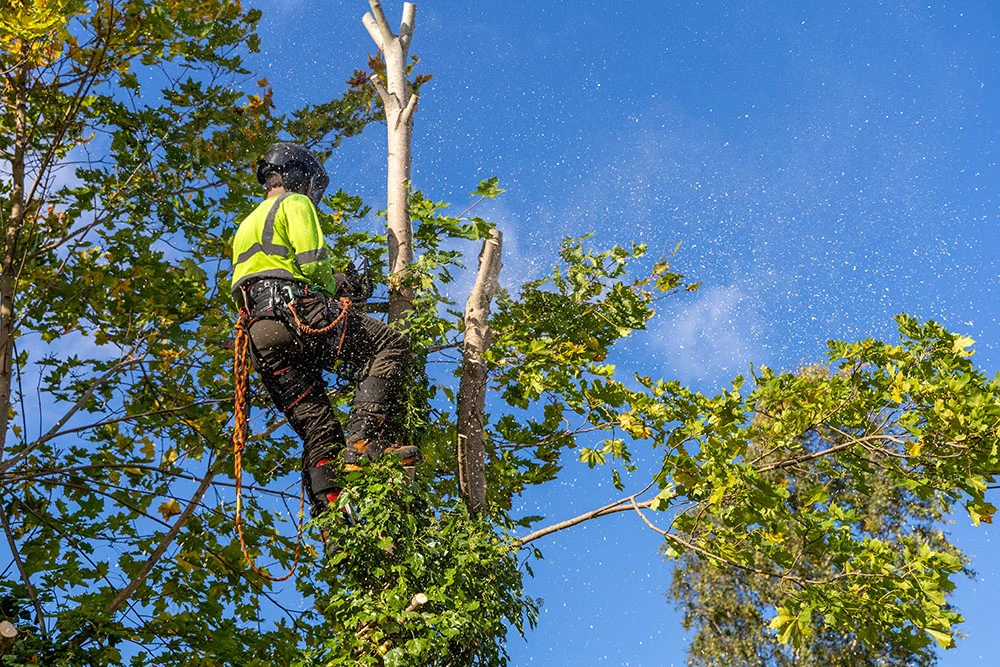
A proper job usually starts with an on-site assessment — checking the lean, the surrounding structures, powerlines, fences, and how much room there is to drop sections safely. Big trees near houses almost always come down in controlled sections rather than one dramatic fell, using rigging to lower limbs rather than letting gravity make the decision. Sydney Tree Felling handles this end to end, from the initial risk check through to the final cut, which matters a lot more than it sounds when you’re dealing with a 20-metre eucalypt hanging over a Colorbond roof.
It’s also worth knowing that NSW councils generally don’t require a permit to remove a tree that’s genuinely dead or posing an immediate risk — but “genuinely dead” is a claim councils increasingly want backed up with evidence, not just a homeowner’s opinion. A written assessment and photos from the crew doing the work go a long way if a neighbour or council officer ever asks questions later. It’s one more reason DIY removal on anything beyond a small backyard sapling tends to cause more grief than it saves.
The Bit Everyone Forgets: The Aftermath
Getting the tree down is only half the job. What’s left behind is a stump, a pile of limbs, and usually a decent scattering of bark and leaf litter across the lawn.
The stump doesn’t just rot away politely on its own timeline — it can take years, attracts termites, and makes mowing a nightmare in the meantime. Stump grinding clears it below ground level so you can actually reclaim that patch of yard, plant something new, or just stop stubbing your toe on it.
If it’s not just one tree but a whole section of overgrown yard, an old orchard, or a block getting ready for a build, that’s a different scale of job entirely — land clearing and site preparation covers exactly that, getting a block ready without leaving root balls and debris behind to cause problems later.
And rather than that timber going to landfill, most of it can be processed on site. Mulching and woodchipping turns branches and offcuts into something genuinely useful for garden beds, which is a far better outcome than a skip bin full of green waste. Whatever’s left after that — offcuts, old fencing that got damaged, general yard debris — a proper rubbish removal clean-up means you’re not the one left hauling branches to the kerb over three weekends.
The Gutter Problem Nobody Connects to the Dead Tree
Here’s a detail most people don’t think about until it’s a soggy mess: a dying or dead tree drops a lot more debris than a healthy one. Bark, twigs, and dead leaves shed constantly in the lead-up to and during removal, and a huge chunk of it ends up exactly where you don’t want it — your gutters.
Blocked gutters aren’t just annoying; they’re how water finds its way into fascia boards, roof cavities, and eventually ceilings. If there’s been a dead or dying tree overhanging the roofline for a while, it’s worth getting gutter cleaning sorted alongside the tree work rather than as an afterthought once you notice a stain on the ceiling.
DIY Chainsaw Jobs: Why It’s Rarely Worth It
Look, there’s no judgement here — plenty of Sydneysiders are handy, and a small dead shrub or sapling is a fair enough weekend job. But once you’re talking about anything with real height, weight, or proximity to a structure, the maths changes fast.
Dead wood is unpredictable. It doesn’t behave like green timber — it can shatter rather than split, drop without warning, and the whole tree can shift once the first major limb comes off. Chainsaw-related injuries involving falling branches are a genuine and recurring cause of serious harm in the tree industry, and that’s with trained crews using proper rigging and safety gear. A ladder, a bloke on a Saturday, and a borrowed chainsaw is a different risk profile entirely.
Add council rules, insurance considerations if anything goes wrong on a shared fence line, and the simple fact that dropping a large dead tree safely in a tight suburban yard takes genuine skill — and it’s easy to see why most people call it in rather than chance it.
Picking the Right Tree Company in Sydney
Not all tree operators are equal, and it’s worth a quick gut-check before booking anyone in:
- Are they insured? Public liability cover matters if something goes wrong near a fence, powerline, or the neighbour’s shed.
- Do they explain the “why,” not just quote a price? A decent operator will tell you if pruning is enough before pushing straight to removal.
- Do they handle the whole job? Felling, stump grinding, mulching, and cleanup as one job is a lot less hassle than juggling four different tradies.
- Can they work around council requirements? Especially for anything that might be a protected or significant tree.
- Do they actually turn up when they say they will? Sounds basic, but ask anyone who’s waited in for a “morning” appointment that showed up at 4pm.
Sydney Tree Felling covers the full spread — from a single hazardous dead tree in a backyard through to full-block clearing — and the team can walk you through the full range of tree services on offer if you’re not sure which job you actually need yet.
FAQs
Do I need council approval to remove a dead tree in Sydney? In most NSW council areas, trees that are genuinely dead or pose an immediate safety risk are exempt from tree preservation controls — but the burden of proof sits with you. Councils increasingly expect photographic evidence or a written assessment confirming the tree is dead, particularly for larger or significant species. Getting that documentation from whoever does the removal is worth doing even when a permit technically isn’t required.
How much does dead tree removal cost in Sydney? It varies quite a bit based on height, trunk diameter, proximity to structures or powerlines, access to the site, and whether stump grinding or full cleanup is included. A small dead tree in an open backyard is a very different quote to a large eucalypt overhanging a two-storey house with limited side access. An on-site assessment is really the only way to get an accurate number.
Can a dead tree come back to life? No — once a tree is genuinely dead (not dormant), it’s not coming back regardless of watering, fertilising, or time. The confusion usually happens with deciduous trees in winter, which can look identical to a dead tree at a glance but will bud again in spring. That’s exactly why a proper inspection matters before anyone assumes the worst — or ignores a genuine problem thinking it’s just a seasonal thing.
What’s the difference between tree lopping and proper tree removal? Lopping usually means hacking off large sections without much regard for the tree’s structure or long-term health, often done by unqualified operators. Proper removal, by contrast, is a planned process — assessing the lean, rigging limbs down in controlled sections, and considering everything around the tree before the first cut is made. It’s slower, but it’s the difference between a controlled job and a genuine hazard.
Will removing a dead tree damage my lawn or garden beds? Some disturbance is normal, particularly around the base where the stump and root plate are, but an experienced crew works to minimise impact on surrounding garden beds, paving, and turf. If the area needs a proper tidy-up afterwards — filling in, levelling or clearing debris— that’s usually rolled into the same job rather than left for you to sort out.
How quickly should I get a dead tree removed once I’ve noticed it? If it’s showing signs of instability — a new lean, cracking near the base, hanging deadwood — treat it as urgent rather than a someday job, particularly heading into storm season. A tree that’s simply dead but structurally stable with no lean and no overhanging structures has a bit more breathing room, but it’s still worth getting assessed sooner rather than later. Dead wood only gets more brittle with time, not less.
The Bottom Line
A dead tree isn’t a problem that improves with patience. It’s one that quietly gets more dangerous every month it’s left standing, right up until a storm, a strong gust, or simple gravity makes the decision for you — usually at the worst possible time. If you’ve been putting off dealing with one, that hesitation is costing you more than the removal job would.
Sydney Tree Felling has spent years sorting exactly this problem for homeowners across the city — telling people straight when a tree can be saved, and handling it properly when it can’t. Have a browse through the blog for more on what to look out for around your property, or if that tree’s already past saving, get in touch and get it sorted before it makes the choice for you.