


22 May Your Trees Are Quietly Wrecking Your Property — Here’s What Sydney Homeowners Need to Know
Let’s be honest — most Sydney homeowners don’t think about their trees until something goes wrong. A branch has punched through the pergola. The gutters are overflowing like Niagara Falls every time it drizzles. There’s a weird lump of dead wood staring at you from the backyard that used to be a perfectly good gum tree.
Sound familiar? You’re not alone. Across Greater Sydney — from the leafy Hills District to the coastal suburbs of the Northern Beaches, from Parramatta to Penrith — trees are a gorgeous, life-giving part of the landscape. But they’re also one of the most overlooked maintenance responsibilities on any property. And when they’re neglected, they don’t just look messy. They become genuinely dangerous.
This guide covers everything you need to know about professional tree care in Sydney: what services exist, why each one matters, when to act, and how a qualified local arborist makes the whole thing significantly less stressful than going at it with a neighbour’s borrowed chainsaw. (We’ve all been there. It never ends well.)
What Does a Certified Arborist in Sydney Actually Do?
First things first — an arborist isn’t just someone with a ladder and a chainsaw. A certified arborist is a trained professional with formal qualifications in arboriculture, the science and practice of tree care. In Australia, that typically means AQF Level 3 through Level 5 certifications. They understand tree biology, disease, structural integrity, root systems, and how Sydney’s unique soil and climate conditions affect different species.
When you hire a qualified arborist in Sydney, you’re getting someone who can:
- Assess whether a tree is genuinely hazardous or just aesthetically untidy
- Advise on council regulations and protected species before any work begins
- Determine the safest and most efficient removal or maintenance method
- Produce formal arborist reports for council development applications
- Recommend long-term care strategies to keep your trees healthy and your property safe
Sydney’s urban canopy includes everything from native eucalypts and angophoras to introduced species like jacarandas, Moreton Bay figs, and London planes. Each has different growth habits, root behaviour, and risk profiles. A good arborist knows the difference — and that knowledge protects you from making costly mistakes.
Sydney Tree Felling fields a team of fully qualified, insured arboricultural professionals who work across residential, commercial, and strata properties throughout the Greater Sydney region. Every crew member holds relevant qualifications — no cowboys, no guesswork.
Tree Felling and Removal: When a Tree Has to Go
There’s a reason tree felling in Sydney is one of the most searched services in the arborist space. Sometimes, a tree simply has to come down. Not everything can be pruned back to health. The question is: how do you do it safely, legally, and without destroying your garden in the process?
When Should a Tree Be Removed?
You should seriously consider professional tree removal when:
- The tree is dead or dying — Dead trees are structurally unpredictable. Branches can drop without warning, especially during Sydney’s summer storms.
- Disease or pest damage is extensive — Some conditions like Phytophthora root rot or borers can compromise a tree beyond saving.
- Roots are causing structural damage — Heaving pavers, cracking foundations, or intruding on underground drainage systems.
- The tree is dangerously close to powerlines or structures — This is a job for licensed professionals, full stop.
- Storm damage has left the tree unstable — Partially uprooted or split trees are ticking time bombs.
- Council approval has been granted — Many Sydney councils have tree preservation orders (TPOs), so removal requires formal approval for certain species and sizes.
How Professional Tree Felling Works
Depending on the tree’s location and surroundings, two main approaches are used:
Straight felling is used when there’s sufficient open space for the tree to fall in a controlled direction. It’s efficient, fast, and cost-effective. Perfect for rural acreage or properties with clear access.
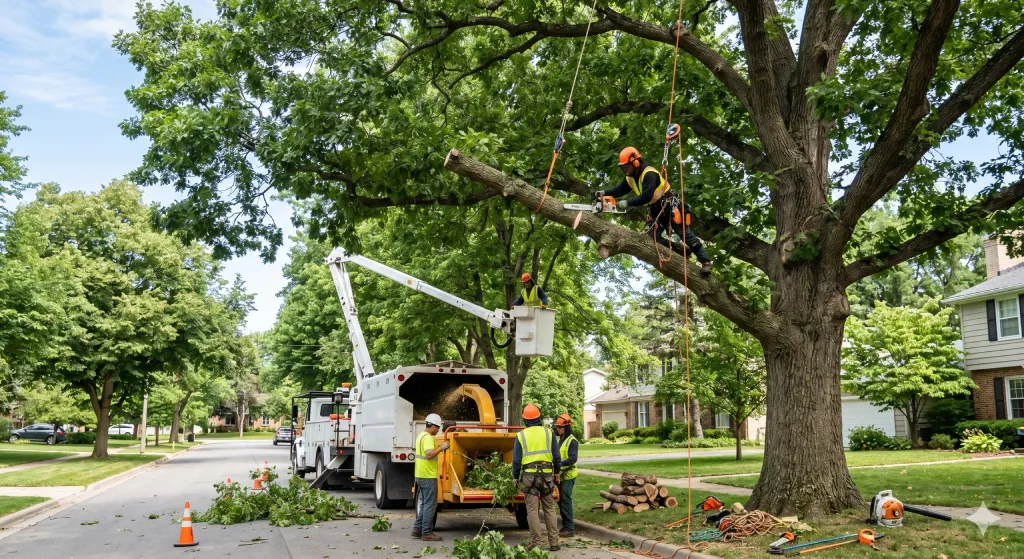
Sectional dismantling is the technique used in urban Sydney — where trees are surrounded by fences, structures, power lines, and other vegetation. Working from the top down, arborists remove sections of the tree using rigging and rope systems to control the descent of each piece. No surprises. No damage to the neighbour’s Colorbond fence.
For large-scale removals in tight spaces, crane-assisted tree removal is sometimes the safest option — particularly for trees over structures or with restricted ground access.
The professional tree removal and felling services from Sydney Tree Felling cover all these scenarios across the city’s diverse suburbs and property types. Free on-site assessments, clear quotes, full insurance.
Tree Trimming and Pruning: The Difference Matters More Than You Think
Here’s where a lot of DIY enthusiasts — and frankly, a few dodgy operators — get it wrong. Tree trimming and tree pruning are not the same thing, and applying the wrong technique to the wrong tree can do lasting damage.
Tree Trimming Sydney
Trimming is primarily about managing growth and appearance. It involves cutting back overgrown branches that are:
- Encroaching on powerlines or neighbouring properties
- Scraping roofs, gutters, or windows
- Blocking natural light to the home
- Creating wind resistance that increases storm risk
- Simply making the garden look like it’s been abandoned since 2008
Seasonal tree trimming in Sydney is typically best done in late winter or early spring, before the new growth flush. For most native species, late summer works well too. Timing matters — cut at the wrong time and you invite disease, stress the tree, or kill off next season’s flower buds.
Tree Pruning Sydney
Pruning is a more targeted, technically precise intervention. It’s about the health and structure of the tree — removing dead, diseased, or crossing branches; lifting the canopy; thinning the crown to reduce wind loading; or shaping young trees to grow in a desired form.
Done well, regular pruning extends the life of a tree, improves fruit and flower production (where applicable), reduces the risk of branch failure, and keeps your property looking sharp. Done badly — think the old “just hack it back to stubs” approach — it causes irreversible damage, stimulates weak regrowth, and creates future hazards.
Sydney Tree Felling’s tree trimming and pruning services are performed by qualified arborists who understand Australian Standards AS 4373 for pruning amenity trees. Proper reduction cuts, clean tools, no lion-tailing.
Stump Grinding: Because That Thing in Your Garden Isn’t Getting Smaller on Its Own
So the tree’s been removed. Job done, right? Not quite. That stump is still sitting there, and it’s going to be there for a very long time if you ignore it. We’re talking decades. Stumps from large eucalypts or camphor laurels can persist for 20–30 years before natural decomposition completes the job. In the meantime, you’ve got:
- A tripping hazard in your lawn
- A breeding ground for termites, wood-boring beetles, and fungal pathogens
- A potential resprout problem (many species will keep trying to come back)
- An obstacle for mowing, landscaping, and any future development
How Stump Grinding Works
A stump grinder is a purpose-built machine with a rotating cutting disc that systematically chips the stump down below ground level — typically 150–300mm, depending on requirements. The result is a pile of wood chip mulch and a level surface ready for turf, garden bed, or whatever you’ve got planned.
It’s fast, clean, and far more practical than chemical stump removal (which takes months) or manual excavation (which takes your entire weekend and probably your back as well).
For stumps near structures, underground services, or in tight access areas, the technique requires an experienced operator. Professional stump grinding and removal ensures the job’s done efficiently without disturbing surrounding roots, drainage, or infrastructure.
Mulch Delivery in Sydney: Turn Tree Waste Into a Garden Asset
Here’s something most people don’t realise: all that green waste from your tree removal doesn’t need to go to landfill. When processed through an industrial wood chipper, branches, limbs, and foliage become high-quality organic mulch — one of the best things you can put on your garden beds.
Why Mulch Matters
Quality wood chip mulch from freshly processed trees:
- Retains soil moisture — Critical during Sydney’s increasingly dry summers
- Suppresses weed growth — Less weeding, more weekend
- Regulates soil temperature — Keeps roots cooler in summer, warmer in winter
- Improves soil structure — As it breaks down, it feeds beneficial soil organisms
- Reduces water runoff — Particularly valuable on Sydney’s sloped, clay-heavy soils
A 100mm layer of coarse wood chip mulch applied around garden beds can reduce water requirements by up to 70%. In Sydney, where water restrictions and summer heat are regular visitors, that’s not a small thing.
Mulch Delivery Sydney
Whether you’ve just had trees removed and want to recycle the material, or you need a fresh bulk delivery to refresh your garden, tree mulching and woodchipping services provide a genuinely sustainable outcome. You get a cleaner yard and a healthier garden in one go.
Blocked Gutter Cleaning in Sydney: The Most Ignored Maintenance Task on Your Property
Let’s talk about gutters for a minute. Specifically, the gutters that haven’t been cleaned since the Howard government.
Sydney’s tree canopy is spectacular. It’s also a relentless producer of leaf litter, twigs, seed pods, bark strips, and the occasional bird’s nest that ends up directly in your guttering system. If you’ve got trees nearby — and in most Sydney suburbs, you absolutely do — your gutters are filling up with organic debris every single season.
What Happens When Gutters Block?
The consequences of blocked gutters go well beyond a bit of overflow:
- Roof damage — Pooled water backs up under roof tiles, causing leaks, rot, and structural damage
- Fascia and soffit decay — Timber and even Colorbond fittings degrade rapidly with persistent moisture
- Pest entry points — Damp, decomposing leaf litter is paradise for mosquitoes, termites, and cockroaches
- Foundation issues — Overflow water directed against the house can saturate the soil around footings
- Fire risk — In dry conditions, accumulated leaf litter in gutters is a genuine ember trap during bushfire season
Sydney’s storm season (typically November through March) is when blocked gutters cause the most damage. The fix? Regular gutter clearing — at minimum twice a year, ideally after autumn leaf fall and again in late spring.
Professional Blocked Gutter Cleaning in Sydney
Professional gutter cleaning services don’t just scoop out debris. A thorough service includes clearing downpipes, checking for sagging or damaged sections, flushing the system with water to confirm free flow, and identifying any early signs of roof or gutter damage that need attention.
It’s one of those jobs that takes an experienced operator about an hour but would take a home handyman a half day, a wobbly ladder, and a subsequent back problem. Leave it to the professionals.
Sydney’s Climate and Your Trees: What You Need to Know Seasonally
Sydney sits in a temperate coastal climate, but its suburbs experience significant variation — from the wetter, cooler Blue Mountains fringe to the hot, dry western plains around Penrith, and the humid maritime conditions along the coast. This variation affects how and when tree care should be done.
Autumn (March–May): Deciduous trees drop leaves — gutter cleaning time. Begin planning winter pruning for dormant species. Ideal time to assess tree health before winter.
Winter (June–August): Best time for structural pruning of most deciduous and many native species. Reduced sap flow minimises stress and disease risk. Stump grinding is efficient in drier conditions.
Spring (September–November): New growth flush — avoid heavy pruning. Ideal time for mulch application before summer heat. Council approval periods often best initiated during spring for summer removal work.
Summer (December–February): Storm season. Time to ensure trees near your home are properly maintained and any hazardous limbs are removed. Gutter systems should be clear before the first big storm.
Understanding this cycle is part of what separates a professional arborist from a bloke who turns up with a ute and a chainsaw. Proper timing protects the tree and maximises the effectiveness of the work done.
Serving Greater Sydney: From the Inner West to the Outer Suburbs
Tree service isn’t a one-size-fits-all proposition in Sydney. A job in Mosman requires completely different logistics to a land clearing project in Campbelltown. Urban density, council regulations, access restrictions, and tree species all vary dramatically across the city.
Sydney Tree Felling operates across all regions of Greater Sydney — including the Eastern Suburbs, Inner West, Hills District, Northern Beaches, South Sydney, Western Sydney, and the Sutherland Shire. Familiarity with local council regulations (and there are a lot of them — every council has its own TPO requirements) is a genuine advantage. No wasted time, no compliance surprises.
Why Qualified and Insured Matters (More Than You’d Think)
The Sydney tree service market has no shortage of operators. Some are excellent. Some are less so. The stakes of getting it wrong are genuinely high:
- Uninsured operators leave you personally liable if something goes wrong — and in tree work, things can go wrong fast
- Improper work on protected trees can result in council fines of up to $1.1 million under the Environmental Planning and Assessment Act
- Incorrect pruning can kill or permanently damage trees that would have been fine with proper care
- Unlicensed operators near powerlines create serious safety hazards and can result in network outages
Sydney Tree Felling carries full public liability and employer’s liability insurance. Every crew member holds relevant qualifications. Work is carried out in compliance with current safety regulations for machinery operation, climbing, traffic control, and the protection of staff and the public.
Recycling of green waste is a priority too — all arising from jobs is mulched and reused wherever possible, rather than sent to landfill. It’s the right approach for Sydney’s environment.
The Full Suite of Services You Actually Need
Here’s the thing about tree care — it’s rarely just one thing. A tree removal often leads to stump grinding. Seasonal trimming creates mulch material. Gutter cleaning reveals roof damage caused by overhanging branches. The jobs connect.
That’s why working with a company that can handle the full scope — rather than juggling multiple contractors — saves time, money, and a significant amount of headache. Sydney Tree Felling’s complete tree services cover everything from the initial consultation and arborist report through to final clean-up, mulch delivery, and gutter maintenance.
One call. Qualified team. Clean result.
Final Word: Don’t Wait for the Tree to Make the Decision for You
In Sydney’s climate, trees move fast. A branch that looks borderline in autumn can become a genuine hazard after one good spring storm. Gutters that seem “mostly fine” in March can be overflowing by June. Stumps that were “leaving for now” become termite condominiums by Christmas.
The good news? Professional tree care isn’t as expensive or as disruptive as most people expect — especially when it’s done proactively rather than reactively. The cost of prevention almost always beats the cost of repairs.
If you’ve got trees, stumps, overflowing gutters, or a general sense that your property’s canopy has been running unsupervised for too long, it’s worth getting a proper assessment from people who know what they’re looking at.
Get in touch with Sydney Tree Felling for a no-obligation inspection and quote. Fully qualified. Fully insured. Locals who know Sydney’s trees.